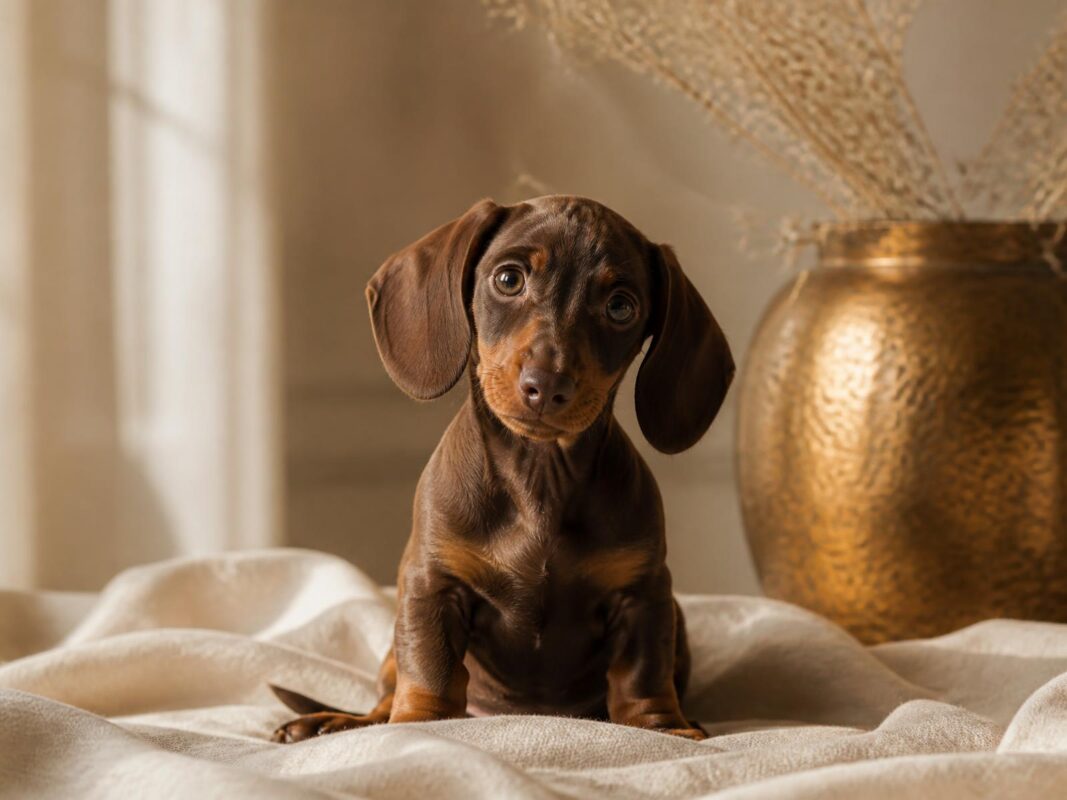
Buying a dachshund puppy: the complete guide from a working breeder
There is no shortage of dachshund puppies for sale online. There is a serious shortage of dachshund puppies for sale from people who can tell you the OFA number of the sire, the calcification history of the dam’s litter mates, and why they chose that particular pairing. This page is our attempt to close that gap. Whether you buy a puppy from us or from another breeder entirely, we would rather you buy well than buy fast.
Dachshunds have been in the top twelve most popular breeds in the United States for over a decade, and popularity is a double-edged sword. It means there is an enormous amount of good information available about the breed, and it also means commercial operations have every incentive to churn out litters with no health testing behind them. The difference between those two sources does not show up at eight weeks. It shows up at three years, when a disc ruptures, or at six months, when a dilute coat starts thinning. Choosing carefully at the beginning is the single highest-leverage decision a dachshund owner ever makes.
How much do dachshund puppies actually cost?
Expect to pay between $2500 and $4,500 for a well-bred, health-tested dachshund puppy from a reputable breeder in the United States. Our own range runs $500 to $2500. Standard smooth coats in classic black and tan or red sit at the lower end. Miniature long coats, dapples, piebalds and champion-bloodline puppies sit in the middle. True English cream dachshunds from verified ee lines sit at the top, because the import pedigrees and testing behind them genuinely cost more to produce.
If you are being offered a “purebred AKC dachshund puppy” for $600, something in that sentence is untrue. Either the papers do not exist, the parents were never tested, the puppy will not be released at eight weeks with a vet exam, or the listing is an outright scam designed to collect a deposit. We have talked more than one family through the aftermath of that last scenario, and it is genuinely heartbreaking.
The purchase price is also not the real number. Budget $500 to $2,200 for the first year: spay or neuter, the remaining vaccination series, a crate, a Y-front harness, a sofa ramp, quality food, pet insurance, and one unplanned vet visit that every puppy owner eventually has. Planning for that up front is part of responsible ownership, and it is why we offer puppy financing and layaway rather than pretending the cost stops at pickup.
Miniature or standard: which dachshund size should you choose?
The American Kennel Club splits the breed by weight at twelve months: miniatures finish at eleven pounds and under, standards mature between sixteen and thirty-two pounds. Everything else in the standard — head shape, chest, coat, colour, temperament — is identical. There is no “in-between” official size in the US, although dogs finishing at twelve to fifteen pounds are common and are affectionately called tweenies.
Choose a miniature dachshund if you live in an apartment, travel frequently and want a dog that fits an in-cabin airline carrier, or simply prefer a smaller dog to lift and carry — and remember that you will be lifting your dachshund a great deal, because stairs and furniture jumps are the two things we ask every owner to eliminate. Choose a standard dachshund if you hike, have a fenced yard, want a dog with more substance around children, or are drawn to the working heritage the breed was actually built for.
One warning that we repeat constantly: avoid anyone selling “teacup” or “micro mini” dachshunds. There is no such variety. Dogs bred deliberately below five pounds carry elevated risk of luxating patella, dental crowding, hypoglycaemia and fragile bone, and the breeders selling them are optimising for a marketing term rather than for the dog.
Understanding the three dachshund coats
Smooth coat dachshunds are the original and the lowest maintenance: a weekly rubber curry mitt is the entire grooming routine. They are the most heat tolerant of the three and the most vocal. Long haired dachshunds carry a silky, feathered jacket from an old spaniel outcross and tend to be the gentlest and quietest of the three coats — they need brushing three times a week and a professional tidy every two to three months. Wire haired dachshunds descend from terrier outcrosses, which shows in both the harsh bearded coat and the extra confidence; their jacket is hand stripped two or three times a year and must never be clippered.
Coat also correlates loosely with health data. Wire haired dachshunds have the lowest reported incidence of intervertebral disc disease of the three varieties; smooth coats have the highest. This is a population-level trend, not a guarantee for any individual dog, and it never overrides the importance of the specific pedigree in front of you.
Dachshund colours and the ones responsible breeders refuse to produce
The breed comes in an unusually wide colour range: black and tan, red in clear and shaded forms, chocolate and tan, cream, English cream, blue, isabella, plus the dapple, piebald, brindle and sable patterns layered over them. Two of these deserve a direct warning.
Double dapple is produced by breeding two dapple dachshunds together. Roughly a quarter of those puppies inherit the merle modifier twice, and the result is frequently deafness, microphthalmia, or missing eyes altogether. We do not produce it, and neither should anyone else. Read the full explanation on our double dapple page before you consider a predominantly white dachshund from two dapple parents.
Blue and isabella dachshunds carry the recessive dilution gene, which is associated with colour dilution alopecia — patchy coat loss and skin sensitivity that typically appears between six months and three years of age. Dilutes are beautiful and genuinely rare, and we will place one to the right home, but only from lines with three clean generations and only after the risk is disclosed in writing. Any breeder charging a premium for a blue dachshund without mentioning CDA is either uninformed or not being straight with you.
English cream deserves a note of a different kind. A true English cream is long coated, descends from British and European show lines, and carries the recessive ee gene confirmed by DNA test. Many dogs sold as English cream in the United States are American shaded creams with no ee result and no import pedigree. Both make lovely pets. Only one justifies the price difference, so ask for the ee test result in writing.
Health testing: what a real breeder can show you
Ask any dachshund breeder these five questions and the conversation will sort itself out very quickly. What are the OFA patella and cardiac results for both parents? What DNA panel was run, and can I see the certificate? Has anyone in this pedigree had a disc episode, and at what age? What is your policy if the puppy develops a hereditary condition at two years old? And what happens if my circumstances change and I cannot keep the dog?
Our answers are on the record. Every breeding parent is OFA patella and cardiac certified and DNA cleared for PRA-cord1, Lafora disease and osteogenesis imperfecta before their first litter. Every puppy is placed with a two-year written genetic health guarantee, plus a ten-day guarantee covering communicable illness present at pickup, and we never require you to return a dog you love in order to claim it. If you ever cannot keep your dachshund, at any point in their life, they come back to us. Those terms live on our health guarantee page in full, not in the fine print.
IVDD: the one thing every dachshund owner must understand
Intervertebral disc disease affects roughly a quarter of dachshunds in their lifetime, and it is the reason the breed carries its reputation for back problems. The mechanism is genetic: dachshunds are chondrodystrophic, which means their discs calcify earlier than other breeds, becoming brittle and prone to herniation. Genetics load the gun; body condition and daily habits pull the trigger.
Three things reduce risk more than anything else. Keep your dachshund lean enough that you can feel the ribs easily and see a waist from above — an overweight dachshund is carrying a constant load on a spine never designed for it. Eliminate jumping on and off furniture with ramps and steps from the first week your puppy arrives, before the habit forms. And walk on a Y-front harness rather than a collar, so lead pressure loads the chest instead of the neck and spine. Families who follow all three see dramatically better outcomes, and we coach every one of ours through it before pickup.
Bringing a dachshund puppy home
The first forty-eight hours set the tone for the next fifteen years. Keep arrival day quiet — no welcome party, no long car detours, no introduction to every neighbour on the street. Show your puppy the potty spot before they come inside, feed on the same schedule and same food we used, and put the crate beside your bed for the first two weeks so the night feels like the litter pile rather than exile.
House training a dachshund is a scheduling exercise, not a battle of wills. Out first thing, after every meal, after every nap, after every play session, and last thing at night. Our puppies start outdoor associations at four weeks, so most families report a fully house trained dachshund somewhere between twelve and sixteen weeks — provided the schedule holds. Socialisation runs on a parallel and much tighter clock: the critical window closes around sixteen weeks, and everything your puppy meets calmly before then becomes normal for life. Aim for fifty new surfaces, sounds and people, all at your puppy’s pace.
What living with a dachshund is actually like
Dachshunds are funny in a way that is difficult to explain to people who have not lived with one. They are hounds, so they are independent, opinionated and led entirely by their nose outdoors. They are also velcro dogs indoors, burrowing under blankets, following you from room to room, and taking any closed door as a personal insult. They bark — at the postman, at the doorbell, at a leaf with suspicious intentions — and teaching a “quiet” cue early is genuinely worth the effort.
They are excellent apartment dogs, provided the walks happen. They are good with children who have been taught to support the chest and hindquarters when lifting. They live twelve to sixteen years, which means the puppy you choose this month is a commitment that will outlast most of the other decisions you make this year. That is exactly why we match on temperament rather than on who applied first.
Nationwide delivery, done properly
We place dachshund puppies in all fifty states. Ground delivery runs by private, climate-controlled vehicle with scheduled stops. Air placements travel in cabin with a flight nanny holding your puppy on their lap — never in cargo, under any circumstances. Delivery cost is quoted before your deposit rather than added afterwards, and we will reschedule rather than transport in unsafe heat. We have declined July deliveries into Phoenix more than once and we will do it again. Our shipping page lays out the full process, and our state guides cover local considerations from Texas heat to New York walk-up stairs.